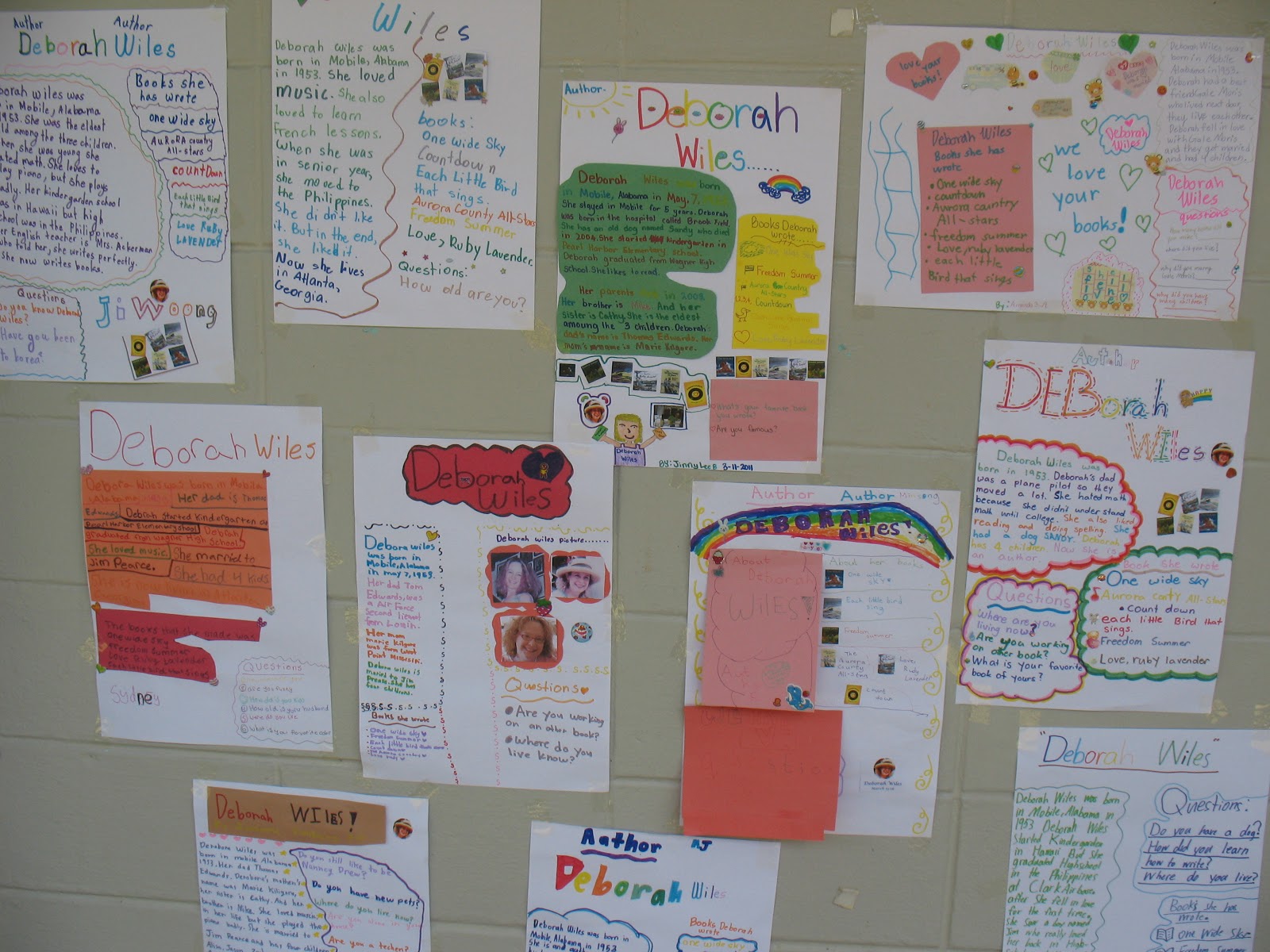
So I went back to work. My second week in the Philippines was spent at Brent International School's Subic Bay campus, which holds classes in the old naval base elementary school. Students had prepared for my visit.
Writing with third graders
Finding fourth-grader Ramon in the library later in the week. "I'm the first person to check out Countdown!" Great, Ramon! "What'cha reading right now?"
Wowee. Ramon's teacher later told me Ramon has checked Hugo Cabret out of the library over and over again. He was so proud to be sitting in the middle school library reading, instead of in the lower school library. "I like the books here," he said. You go, Ramon.
First and second graders get ready to sing the song Jim wrote that accompanies One Wide Sky. It was fabulous!
Heading out of the Subic compound and into the city of Olangapo with librarians Angelo Fernandez and Rose Austria.
our jeepney! I sat right up front behind the passenger seat and forked over my fare.
The public market in Olongapo.
Our chariot home. Ghelo will sit behind the driver.
Thanks for the ride!
I'm working at Robert E. Lee Elementary School in Spotsylvania, Virginia today. No jeepneys, no trikes, no steamy tropical heat. But we will be singing One Wide Sky in kindergarten and first grade.
In the upper elementary grades we will be talk about Ruby and Comfort and House Jackson and Mississippi and "what's your story?"
Kids will bring notebooks and we'll begin the working of writing our stories. I will carry the memories of the Philippines with me, all those amazing students, all those fabulous teachers, all those teaching and learning moments, both in the classroom and out.
Thank you so much to everyone who worked so hard to bring me to the Philippines. I will never forget your hard work and kindnesses. I will always treasure the people and experiences I had there, both as a young girl and a grown woman. The past informs the present. It tells us who we are.
Everything is story material. Story is everything. And now I am home, and in Virginia. I'm very glad to be here. Off I go.
Showing posts with label the philippines. Show all posts
the homesick weekend
I didn't think I could go back to Clark. It had made me too sad. In fact, the Philippines was filling me with grief. I spent the weekend at a lovely resort-type place on Subic, all by myself, crying about the poverty I had seen all week long outside the compounds where I lived and worked, railing against the effects of long-term colonialism in the Philippines, grieving for a past I never made peace with, and journaling long into the night.
I was confused by what I didn't understand, and I was exhausted from the work week, from the jet-lag, and from the homesickness. Homesick for my parents who died seven years ago. Homesick for who we all were, for that time in our lives. Heartsick about Clark and wondering how memory and time works on the heart. Homesick for a sense of comfortability and safety in a country with infrastructure and without armed guards at checkpoints along the roadways and at entrances to private compounds everywhere.
And yet, even in the midst of the noise and dirt and poverty and pollution of the cities, there was such beauty and amazement -- and a rainforest. It was like whiplash to be here.
I didn't think I could go back to Clark. But as I journeled in my notebook, and as Sunday's quiet, still, beautiful day worked its magic on me, I got some perspective, and on Monday, as Rose Austria, the lower school librarian at Brent Subic, picked me up with driver Jay, I said, "let's go," and we went back to see what we could see.
We left the parade ground and drove up to hill housing again, where Rose worked her magic and a supervisor was called, and we were allowed to go through the gate, as long as we left the car and walked the whole way, which we did.
Colonel's families lived here for years and years. Now it's going back to jungle, and there are only ghosts. The guards passed us on motorbikes now and then, and some walked with us, unsure of us at first, but then trying to help me find my house. I knew where it was.
Jay and one of the Negrito guards made a path for us.
I told the story of how I stood under that overhang at night with a boyfriend delivering me home after a date, how I kissed him goodnight at the front door, and how my father watched us from the bathroom window. They all laughed.
Below, the overhang with bathroom window on left, and front door next to that. i was kissed there. I am mulling and mulling now, about the changes that time brings, and what it means to memory. Of course, that is a big part of the thinking behind my fiction as well. I know this trip will inform my work. And my heart.
Everyone was willing to be in the pictures now. We celebrated finding the house.
By now we were friends. (That's librarian Rose on the right.) I rode down the hill on the back of a guard's motorcycle -- really! -- and then we were invited for lunch. What a rare gift.
Rice spread on banana leaves, fish soup, and adobo. Below: where lunch was cooked, on an open fire at the back of the nipa hut/guard house:
Time to say goodbye. The man wearing the goggle-glasses built the hut. He is also a pastor.
What a difference a day makes. I left Clark having made friends and having found the place where I'd lived for that pivotal senior year in high school. Time has changed everything. Is that not time's purpose? I don't know. I know that I felt better. I had Rose and Jay and a lifetime of memories in the car with me as we drove the hour back to Subic and the room that would be my home for the next week.
We drove past a river that had been completely destroyed as the lava flow from Pinatubo sucked up its water twenty years ago. We drove past rice fields in various stages of cultivation/harvest. We had left behind the paper shacks of Manila and the poverty in Angeles and Pampanga and we drove toward Subic Bay.
Earlier in the week I had been talking with Westerners about my ambivalent feelings about Westerners' history in the Philippines and what had developed as a result. A new friend said, "The Philippines will break your heart, if you don't learn how to live here and give back in a meaningful way."
I spoke with a Filipino in Manila, about the same thing. He had said, "I like the Americans being here. There is such danger here, which is why you see guards at checkpoints and private roads and so much security -- there are car-nappers, kidnapping, there are gangs, there is much to be afraid of... and you are right, there is little infrastructure. There is so much poverty. I like the American presence. It tempers the dangers..."
And so I thought about Clark -- and now, Subic. Had it been a good thing that the Americans had been such a strong presence in the Philippines? It seemed so, and yet it also was such a complex thing -- it was impossible to answer it in black and white terms.
So I journaled through my ignorance and asked my questions and wondered if I would ever become clear. And then, I began my work at Brent Subic. One thing I was sure of: this experience was changing my life.
Labels:
the philippines,
traveling
first trip back to clark
I am home from the Philippines, where there was little time or adequate internet connection for blogging, but lots of photos were taken. The next few posts will be catch up photos as *I* catch up on sleep, mail, and home tasks.
Angeles City, outside of Clark. I am traveling from Manila to Subic Bay, having worked at Brent's Manila campus all week, and now traveling to the Subic campus, three hours away, where I'll have the weekend off and start teaching again on Tuesday morning. Clark was an hour from Subic, and Brent's driver Roy was kind enough to take me there on the way.
When I rolled down my window to take a photo in Angeles City, a small child ran to my car with her hand outstretched.
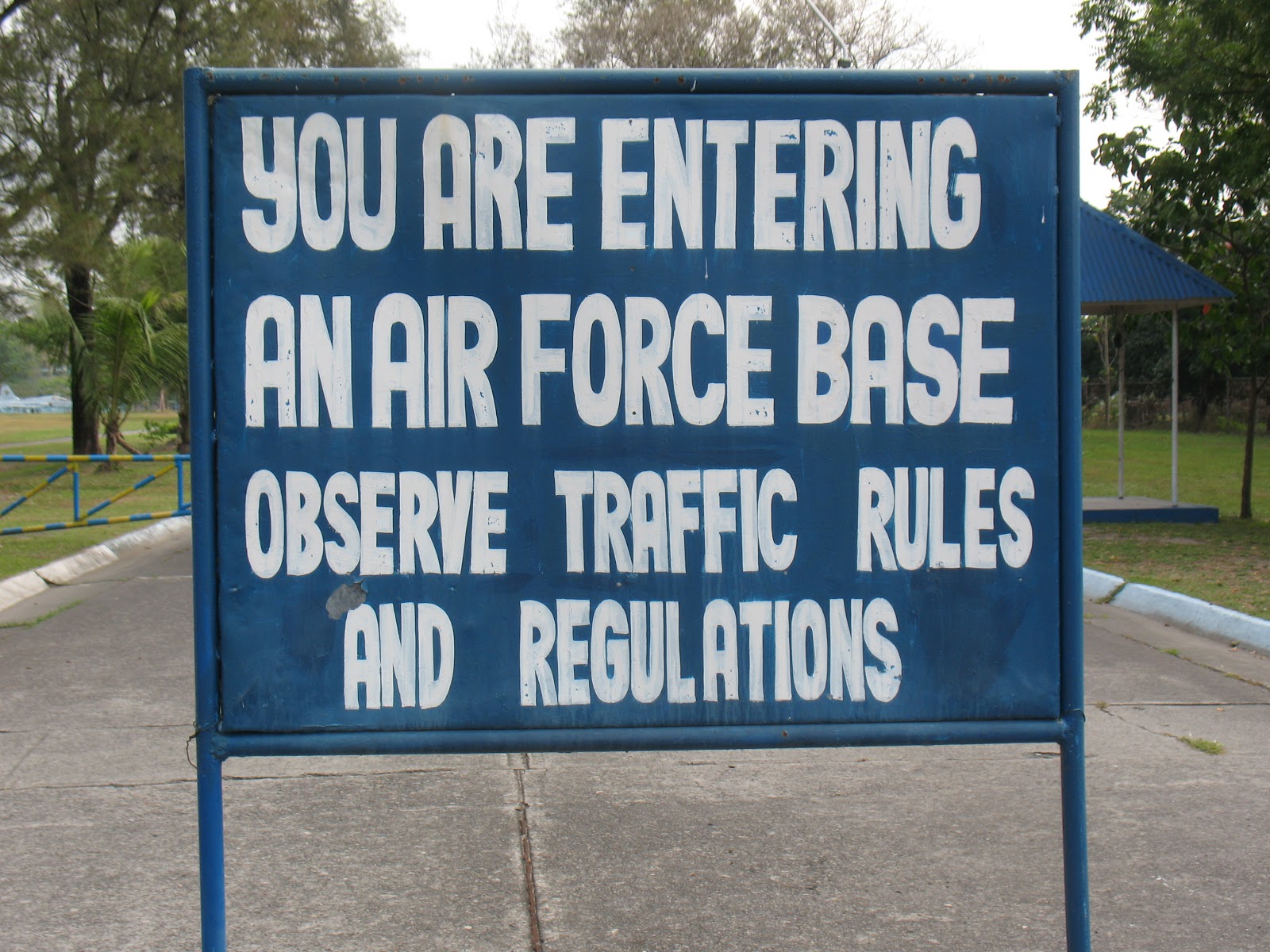
There is no longer an American presence at Clark, as the Air Force left in 1991 after the Mount Pinatubo eruption covered Clark in volcanic ash (and a typhoon made matters worse), and the Philippine government refused to renew the American contracts for an air force base at Clark and a naval base at Subic Bay.
Clark was a ghost town for close to a decade after Pinatubo. Today the Philippine Air Force occupies part of Clark, some commercial flights fly into and out of Clark, and Filipino businesses have taken over some of the structures. The Clark Development Corporation is working on redeveloping Clark. People have moved into the more desireable empty barracks and houses.
At one time, Clark Air Base was the most urbanized overseas military base in the world. I lived there from 1970 to 1971 and graduated high school at Wagner High on Clark. The building below was part of a complex that housed the base commander and administrative offices. It is now home to the Clark Development Corporation. So much of Clark was covered with ash for so long...
My former high school is now home to Clark Aviation -- a pilot school -- as well as Philippine Immigration and the Philippine Justice Dept.
We drove from the high school up to hill housing, where I used to live. All the homes on the hill look like this now.
I was not allowed to pass into the housing area. This is the guard house at the entrance to hill housing. I was told that the land has been sold to Korean and British interests and will be eventually turned into a golf course and new housing.
The guards had guns and I didn't argue. But this was Saturday. I was scheduled to return on Monday, which I did... and I did get up to my old house. Stay tuned.
If you are interested, you can find all the captioned photos of the first trip to Clark here.
I was dropped off at The Camayan, in Subic Bay, after this trip, and spent the weekend recovering from a hard but rewarding week working at Brent's Manila campus. Next, the Camayan over the weekend, and the trip back to Clark and my home there, which is now jungle, but hey. It was a memorable trip back in time, and involved a motorcycle ride and lunch with my new friends, the armed guards, in their nipa hut. It was unforgettable.
Labels:
the philippines,
traveling
Subscribe to:
Posts (Atom)